
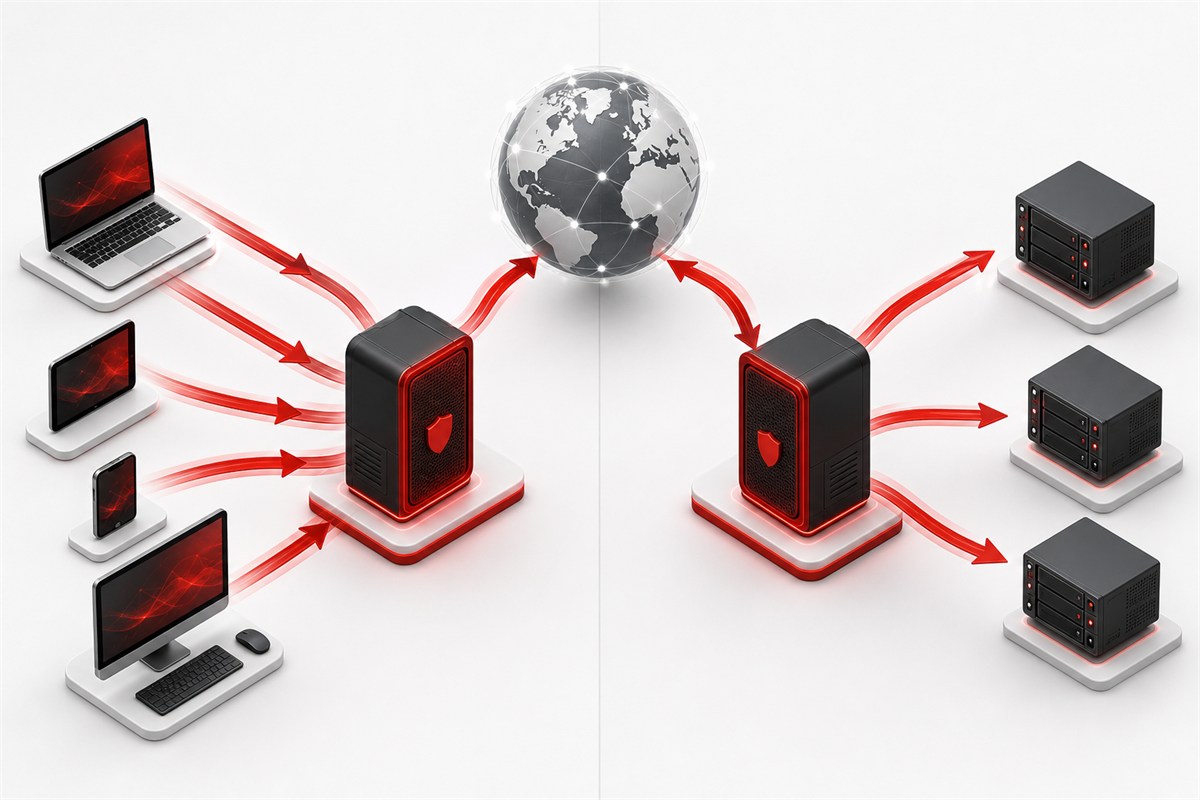
A forward proxy sits on the client side of a connection and sends outbound requests on behalf of configured clients. A reverse proxy sits in front of origin servers and accepts inbound requests on their behalf. The packets can travel through similar software, but traffic direction, configuration ownership, and the protected side are different. If users or applications choose the gateway, it is usually a forward proxy; if the website operator places the gateway before its origins, it is usually a reverse proxy.
Scope: this guide compares conventional application forward proxies with web reverse proxies. It does not treat every transparent gateway, service mesh, CDN, load balancer, or NAT device as interchangeable. Review the basic proxy request path first, then use the Proxy Basics hub for protocol and access-model decisions.
The difference in one diagram described in words
For a forward proxy, the path is client → forward proxy → destination. The destination normally sees the forward proxy as the connecting peer. The client or its network administrator knows about the proxy and supplies its address, protocol, and authentication.
For a reverse proxy, the path is visitor → reverse proxy → origin service. The visitor connects to the public hostname and may not know which origin receives the request. The site operator controls the public DNS, reverse-proxy listener, certificates, routing policy, and origin pool.
| Dimension | Forward proxy | Reverse proxy |
|---|---|---|
| Represents | Clients making outbound requests | Servers receiving inbound requests |
| Configured by | Client user or client-network owner | Website or service owner |
| Address hidden from the far side | Client address from destination | Origin address and topology from visitor |
| Typical policy | Outbound access, routing, filtering | Inbound routing, TLS, caching, protection |
| Common failure | 407, CONNECT failure, route timeout | 502, 503, upstream timeout |
Traffic direction defines the role
“Forward” and “reverse” describe which side the intermediary represents, not whether bytes literally move in only one direction. Every successful HTTP exchange has requests and responses. The forward proxy is selected on the outbound side and establishes a connection toward a destination. The reverse proxy receives traffic addressed to the service and selects an origin behind it.
The same server package can sometimes perform both roles with different configuration blocks. That does not erase the security distinction. An unrestricted forward proxy exposed to the internet can be abused as an open relay. A reverse proxy configured to accept arbitrary CONNECT targets can accidentally become one. Bind listeners narrowly, define allowed methods and destinations, and test what the gateway refuses.
Client ownership and forward-proxy configuration
With a forward proxy, client ownership includes deciding which applications use the route. Settings may live in a browser profile, command-line flag, environment variable, library transport, operating-system panel, or managed network policy. One setting rarely covers every program. This is why a changed IP in one browser tab does not prove that updates, DNS, native applications, and background tasks share the route.
The client must also understand the proxy protocol. An HTTP proxy receives HTTP requests and can be asked to create a tunnel for other TCP traffic supported by the client and gateway. SOCKS provides a more general relay interface. The MDN guide to proxy servers and tunneling explains common HTTP proxy behavior and tunneling concepts.
Authentication belongs to the client-to-forward-proxy boundary. A 407 response indicates that the proxy requires or rejects proxy credentials. Destination authentication is separate: a 401 from an application after a tunnel succeeds belongs to the destination. Mixing these credential scopes creates confusing failures and can expose secrets to the wrong system.
Server ownership and reverse-proxy configuration
With a reverse proxy, server ownership includes the public hostname, listener, certificate, upstream addresses, health checks, retry rules, header policy, request limits, and logs. Visitors normally configure nothing beyond the service URL. The reverse proxy can distribute traffic among origins, terminate TLS, cache selected responses, enforce request-size limits, and keep private origin addresses off the public path.
The official NGINX reverse proxy guide shows how requests can be passed to upstream servers and how request headers are adjusted. The exact directives are product-specific, but the architectural lesson is general: the service owner must deliberately define upstream selection and the information passed across the boundary.
A reverse proxy does not automatically make an insecure origin secure. Origins should accept traffic only from expected networks or authenticated gateways where possible. Administrative interfaces should remain separate. TLS between reverse proxy and origin may still be required, especially across shared or untrusted networks.
Follow one request path at a time
Consider a developer using a forward proxy to call an HTTPS API. The client connects to the proxy, authenticates if required, requests a tunnel to the API host, negotiates TLS with the API through that tunnel, and sends the request. The API sees the proxy’s public exit as the network peer. The forward proxy may see the target host and connection metadata, while application content remains protected by correctly validated TLS.
Now consider a visitor loading a website behind a reverse proxy. DNS points the hostname to the reverse proxy. The visitor negotiates TLS with that public edge. The edge inspects the HTTP request, selects an origin, sends a new upstream request, receives the response, and returns it to the visitor. Depending on configuration, the origin sees the reverse proxy’s address and selected forwarding headers.
A request can use both roles: client → forward proxy → reverse proxy → origin. Debugging becomes easier when each hop is named. Record which component created a status code, which certificate was presented, which DNS name was resolved, and which log owns the request identifier.
Headers and client addresses are policy, not magic
Reverse proxies often add or rewrite forwarding headers so an origin can learn the original client address, public scheme, or host. Those headers are trustworthy only when the origin accepts requests exclusively from trusted proxies and the proxy replaces untrusted inbound values. If the origin is public, a visitor can forge a header that merely looks authoritative.
Forward proxies may add diagnostic headers, but privacy-sensitive deployments often minimize unnecessary disclosure. Some destinations can still correlate accounts, cookies, TLS or browser behavior, and request timing. The network peer address is only one signal.
Define a header contract: which gateway writes each value, which hops may append, what the origin trusts, and what logs retain. Redact credentials and session tokens. A request ID can help trace a path without recording an entire sensitive response body.
TLS boundaries differ
For an HTTPS destination through a conventional forward proxy tunnel, the client normally validates the destination certificate. The proxy carries encrypted bytes after tunnel establishment. If a managed inspection proxy deliberately terminates TLS, devices need an organization-controlled trust configuration and users need clear governance; disabling validation is not a safe substitute.
A reverse proxy often terminates public TLS and therefore owns the public certificate and private key. It can create a second TLS connection to the origin. Teams should monitor both certificate lifecycles, validate upstream hostnames, and prevent downgrade to an unprotected origin link unless the network design explicitly allows it.
The question “does the proxy use HTTPS?” is incomplete. Ask which two endpoints are protected on each leg, who validates whom, and where plaintext application data is available.
Common use cases without mixing the roles
Forward proxy use cases
- Give an authorized application a stable outbound IP for an allowlist.
- Run controlled regional checks from a specific client.
- Apply outbound access policy for a managed network.
- Separate test traffic from a developer’s direct connection.
- Record gateway-level connection evidence for troubleshooting.
Reverse proxy use cases
- Route one public hostname to several application origins.
- Terminate TLS and centralize certificate operations.
- Apply request limits, caching, compression, or web protections.
- Keep origins private and move them without changing the public endpoint.
- Perform health-aware load distribution and controlled maintenance.
A CDN is commonly implemented with reverse-proxy behavior at distributed edges, but a CDN also includes caching, network, and control-plane features. A load balancer can be a reverse proxy at the application layer or a lower-level transport device. Name the behavior you depend on instead of using product categories as exact protocol definitions.
Verification for a forward proxy
- Capture a direct baseline from the exact client.
- Enable the proxy only for that client and request a neutral HTTPS IP endpoint.
- Confirm the observed exit matches the assigned proxy and TLS validation remains enabled.
- Test the intended destination with a safe request and preserve status and timing.
- Run a second application that should remain direct to prove routing scope.
- Remove the configuration and confirm the baseline returns.
Use the layered proxy test when you need a reproducible sequence rather than a single checker result.
Verification for a reverse proxy
- Confirm public DNS resolves to the intended edge.
- Inspect the public certificate, hostname, protocol, and security headers.
- Send a request with a unique non-secret identifier and trace it from edge to origin.
- Temporarily remove one test origin from service and confirm health-aware routing behaves as designed.
- Verify origins reject unintended direct public access.
- Test request limits and error pages without generating harmful load.
Expected observation: a forward-proxy test changes only the intended outbound client path, while a reverse-proxy test reaches the public edge and then exactly one healthy approved origin with traceable headers and logs.
Troubleshoot by the component that answered
| Signal | Likely owner | First check |
|---|---|---|
| 407 | Forward proxy | Credentials, account state, or source-IP allowlist |
| CONNECT rejected | Forward proxy policy | Target host, port, and allowed methods |
| 502 | Reverse proxy or gateway | Upstream address, health, protocol, and logs |
| 503 | Reverse proxy or application capacity | Healthy upstream count and maintenance state |
| Wrong certificate | Listener, SNI, or DNS | Requested hostname and selected virtual host |
| Origin records wrong client IP | Header trust policy | Edge rewrite and trusted-proxy configuration |
The common proxy errors guide is useful for outbound failures. For inbound failures, correlate reverse-proxy and origin logs with a safe request identifier and synchronized timestamps.
Ask ownership questions before selecting software
Who configures the gateway? Which side must be represented? Is the requirement outbound routing or inbound service delivery? Which protocols and ports are allowed? Where does TLS terminate? Which component owns DNS? What header information crosses the boundary? How are secrets stored? What happens during gateway or origin failure?
If the need is an authorized application’s stable outbound route, define endpoint count, protocol, authentication, location, and support requirements before comparing proxy pricing. If the need is to publish and protect an owned service, select and operate a reverse-proxy platform instead; buying forward-proxy endpoints will not solve that architecture.
Responsible-use boundary: do not expose an open relay, do not forward traffic to unauthorized targets, restrict listeners and destinations, protect credentials, and keep request rates within approved limits.
Can a reverse proxy invalidate an exit-IP observation?
An IP-checking application behind a reverse proxy may receive the reverse proxy’s address unless the deployment applies a verified client-address policy. Identify what field the checker actually reports before interpreting it as internet egress. Forwarded headers require an explicit trusted boundary; arbitrary client-supplied header values are not address evidence.
For the related implementation or diagnosis, interpret the checker’s observed fields.