
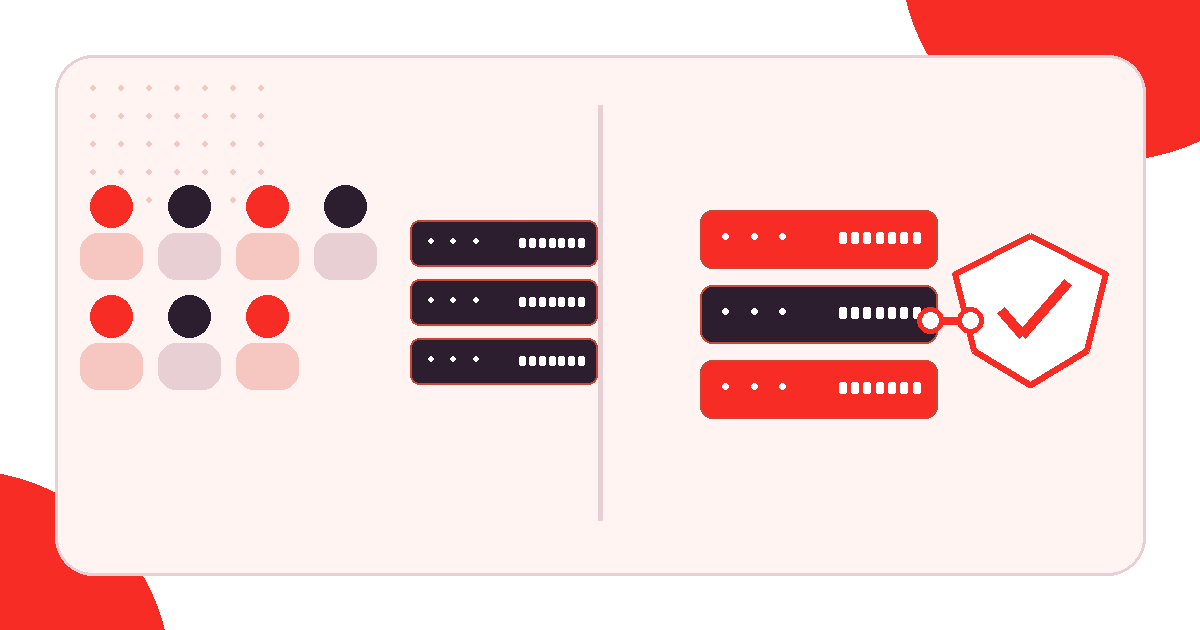
A free public proxy trades purchase price for uncertainty about ownership, access, capacity, logging, reputation, and support. A private proxy is assigned under a controlled service relationship, usually with authentication and an accountable support path. Neither option guarantees anonymity or destination acceptance, but the private model gives important work a more reproducible network boundary.
Scope: this guide compares operating models and total cost. For a threat-focused review of unknown endpoints, read free proxy server risks; for the broader selection framework, visit the Proxy Basics hub.
Ownership and accountability
A free list may contain intentionally public servers, abandoned tests, misconfigurations, or compromised devices. The list publisher may not operate them. Without a verified operator, there is no reliable party to answer questions about logs, maintenance, jurisdiction, or an incident.
A private service should identify the provider, assignment terms, acceptable-use policy, privacy information, and support contact. Confirm whether the address is exclusive during the assignment and how replacement works. Private describes access control, not permanent ownership or a universal clean reputation.
Authentication and credential control
Open public proxies often accept anyone, which encourages congestion and abuse. Private endpoints normally require a username and password, source-IP allowlisting, or both. Credential authentication fits clients whose public address changes; allowlisting fits servers with stable egress.
MDN documents HTTP 407 as the proxy-authentication-required response. Treat it as a proxy-boundary failure: verify the configured method, rotate exposed secrets, and avoid repeated guesses. The proxy authentication guide covers the two models.
Performance and repeatability
Public endpoints share unknown bandwidth and CPU with unknown users, so latency and availability may change without notice. A private service can plan capacity and restrict access, making results easier to reproduce. Distance, routing, client configuration, and destination load still matter; paid does not automatically mean faster.
Expected observation: a suitable endpoint should authenticate consistently, present the promised exit behavior, and complete a harmless authorized request repeatedly. Intermittent timeouts, changing protocols, certificate warnings, or unexplained content changes are failure signals, not normal variance to ignore.
Support and replacement
When a free endpoint fails, the usual remedy is to pick another address and rebuild the session. A provider can investigate routing, authentication, or an offline assignment and apply documented replacement rules. Competent support also separates a healthy proxy with a destination 403 or 429 from a broken route.
Support cannot promise that every site accepts an address. A destination block may require slower requests, an official API, additional authorization, or stopping. Repeated replacement is not a responsible way to push through access controls.
Total operational cost
The cost of a free proxy includes discovery, repeated configuration, failed jobs, monitoring, session repair, security review, and incident risk. For a disposable public-page experiment with no sensitive data, that effort may be acceptable. For scheduled work, staff time and inconsistent results can exceed the endpoint price.
Paid plans also have constraints. Compare billing period, bandwidth, concurrency, session behavior, quantity, support, and replacement terms using current provider documentation. Start with the smallest representative endpoint set and measure the same destination at the same conservative schedule.
Privacy, authorization, and rate limits: use HTTPS with certificate validation, never expose proxy passwords in code or tickets, avoid sensitive accounts on unknown routes, and respect destination permission and rate controls regardless of payment model.
Choose the controlled model only after testing the requirement
Write down whether the work includes accounts, client data, stable allowlists, scheduled runs, or a support obligation. If those requirements call for exclusive controlled access, compare the current private proxy offering after one endpoint passes the same exit, TLS, stability, and destination tests described in the verification guide.